For more than a decade, the conversation surrounding Artificial Intelligence has been dominated by one assumption: replacement.
Machines replacing workers. Automation replacing relationships. Algorithms replacing human judgment.
But as AI becomes increasingly capable, a different question is beginning to emerge beneath the technological excitement:
What happens when intelligence scales faster than human connection?
Consumers do not automatically trust technology simply because it is advanced. In sectors involving emotional and financial risk, excessive automation can sometimes produce the opposite effect. Studies in healthcare and finance increasingly suggest that while AI improves efficiency and analytical capability, people still look to humans for reassurance, interpretation, empathy, and trust.
This tension between efficiency and human confidence is beginning to reshape industries far beyond medicine and banking. Real estate may become one of the clearest examples.
Advanced technology alone does not automatically create trust.
Over the last several years, the industry has rapidly accelerated toward AI adoption. New platforms promise predictive analytics, automated marketing, lead scoring, instant communication, and scalable content generation. Efficiency has become the dominant language of digital transformation.
But beneath the enthusiasm surrounding automation, another reality is beginning to surface: efficiency alone is no longer enough to create differentiation.
As AI-generated communication floods the digital environment, authenticity becomes more valuable, not less.
Credibility does not.
The paradox is becoming increasingly visible across industries. The more communication becomes automated, the more consumers gravitate toward experiences that feel trustworthy, contextual, and human.
AUTOMATED COMMUNICATION
• Scalable
• Instant
• Abundant
• Efficient
HUMAN VALUE
• Trustworthy
• Contextual
• Emotional
• Strategic
In practice, this changes the role technology plays inside modern businesses.
Rather than replacing professionals entirely, AI increasingly functions best as infrastructure that organizes information, accelerates workflows, identifies patterns, and reduces operational friction. Human value shifts elsewhere: toward judgment, interpretation, emotional intelligence, strategic thinking, and trust.
In real estate, that distinction matters enormously.
Property decisions rarely revolve around functionality alone. Beyond pricing, location, or square footage, buying a home is deeply connected to aspiration, identity, security, belonging, and life transition.

Technology can accelerate search, streamline communication, and improve access to information. But it cannot fully replace the emotional and psychological dimensions involved in major human decisions.
This distinction is beginning to force a broader reconsideration of how intelligent systems should be designed in the first place.
The dominant assumption of the early AI era was largely linear: humans transfer tasks to machines, machines execute them faster, and human participation gradually decreases over time.
But that model may prove incomplete.
At NEO, the underlying philosophy behind the platform’s infrastructure evolved in a different direction. Rather than viewing Artificial Intelligence as a mechanism for replacing human participation, NEO is designing its ecosystem around the continuous interaction between Artificial Intelligence (AI) and Human Intelligence (HI).
The premise is relatively simple:
NEO INTELLIGENCE FRAMEWORK
Human Intelligence informs Artificial Intelligence.
Artificial Intelligence amplifies Human Intelligence.
In practice, this creates a continuous feedback cycle rather than a replacement cycle. The system becomes more intelligent without forcing the human element to disappear.
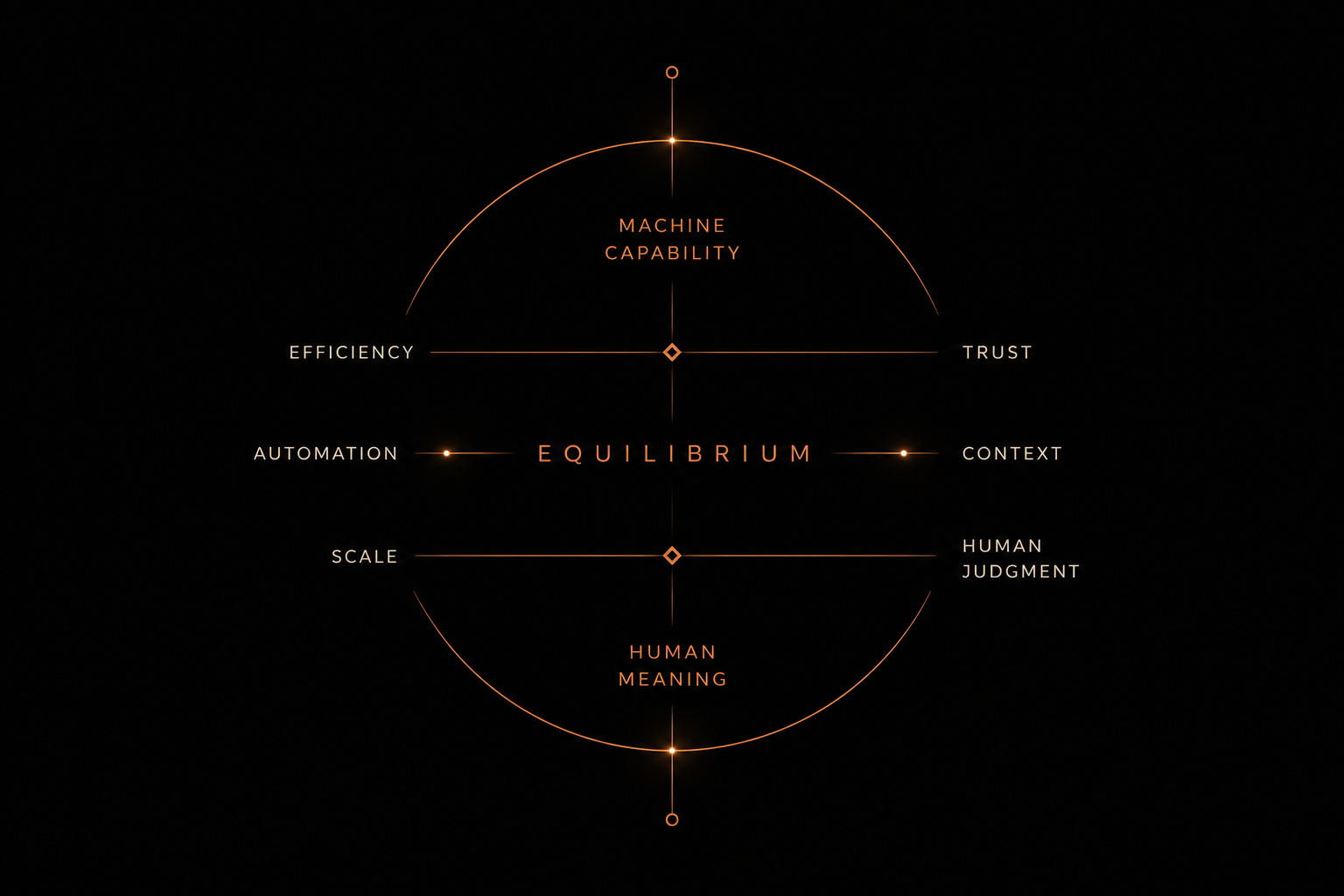
The objective is not technological dominance over human decision-making, but equilibrium between machine capability and human meaning.
A form of operational homeostasis where machine intelligence increases efficiency while human intelligence preserves the contextual depth, emotional understanding, and trust that complex decisions still require.
That balance becomes especially important in real estate.
Because while technology can accelerate transactions, human beings still make decisions emotionally, psychologically, socially, and relationally.
A home is never simply a product of data.
It represents:
The architecture of a future life.
And that is precisely why the relationship between AI and HI may become more important, not less, as intelligent systems continue to evolve.
This shift is already becoming visible across the broader economy.
As synthetic content proliferates online, audiences increasingly reward credibility, originality, and human intentionality over sheer volume of machine-made content. Consumers may admire and even be amused by technological sophistication, but they still attach deeper value to what they perceive as authentically human.
That distinction matters.
Human originality becomes increasingly valuable
Societies do not merely reward efficiency. They reward authorship, originality, and meaning. The value people assign to art, storytelling, design, strategy, or communication has always been connected not only to the outcome itself, but to the human intelligence, creativity, and intentionality behind it.
Artificial Intelligence may dramatically increase the scale of content creation. But scale alone does not automatically create emotional value, cultural significance, or trust.
In many ways, the widespread proliferation of AI-generated output may ultimately increase the premium placed on human originality rather than diminish it.
Because when synthetic creation becomes abundant, humanity itself becomes scarce.
And scarcity creates value.
The implications extend beyond marketing or communication strategy. They affect how companies design platforms and define the relationship between humans and intelligent systems.
The most effective AI ecosystems may not be the ones attempting to remove human participation entirely. They may be the ones capable of integrating machine intelligence with human judgement in ways that strengthen both.
That balance becomes especially important in industries dependent on relationships, negotiation, and emotional confidence.
Real estate remains, at its core, a profoundly human business.
Even in an increasingly digital environment, buyers still seek guidance, interpretation, reassurance, and trust from people, not simply from systems. Technology may optimize the transaction, but human intelligence continues to shape the decision itself.
This philosophy increasingly defines the next stage of intelligent real estate infrastructure.
Rather than functioning merely as listing portals or transactional utilities, platforms should evolve into collaborative ecosystems where AI expands professional capability without eliminating the human dimension that gives meaning to complex decisions.
The objective is not to make real estate less human.
It is to make human intelligence more capable and scalable.
That distinction may ultimately define the most important choice of the AI era itself.
The future of Artificial Intelligence is not predetermined. Human beings will decide whether intelligent systems are designed to gradually replace human participation, or to strengthen the value of human Judgment, Creativity, Trust and Connection.
NEO is being built around that second vision.
Not because technology should advance more slowly, but because its advancement should remain connected to human meaning.
The future should belong to systems capable of combining the speed of Artificial Intelligence with the contextual depth and emotional understanding that Human Intelligence alone can provide.