
In 1885, real estate brokers in San Diego began doing something that, by today’s standards, seems almost quaint. Twice a day, member offices of the local real estate board were expected to provide one another with lists of properties that had been offered for sale, sold or withdrawn. Clerks carried the information from brokerage to brokerage by hand.
The technology was primitive. The idea was not.
Those brokers had recognized a fundamental truth about real estate: a market works better when the professionals within it can see beyond their own inventory.
The practice spread. Other cities created their own exchanges. By 1922, fifty real estate boards were operating some form of multiple listing service, with new ones appearing at a rate of roughly two per week. Eventually, index cards gave way to listing books, listing books to computers, and computers to the sophisticated digital systems used today.
The Multiple Listing Service (MLS) became one of the most consequential pieces of infrastructure in American residential real estate.
The Time Dimension
The MLS is built around individual properties as they exist at a given moment in time.
A home exists at 123 Main Street. It has three bedrooms, two bathrooms, 2,100 square feet and an asking price of $475,000. The details around it may change. The price may change. Its status may change. But the object at the center of the listing remains the same: an existing home at 123 Main Street.
New construction is different in a way that is easy to miss until one stops thinking about the home and begins thinking about time.
A new-construction community is not simply a place containing homes for sale. It is something unfolding.
If resale is a snapshot, new construction is a moving picture.
The Architecture of New Construction
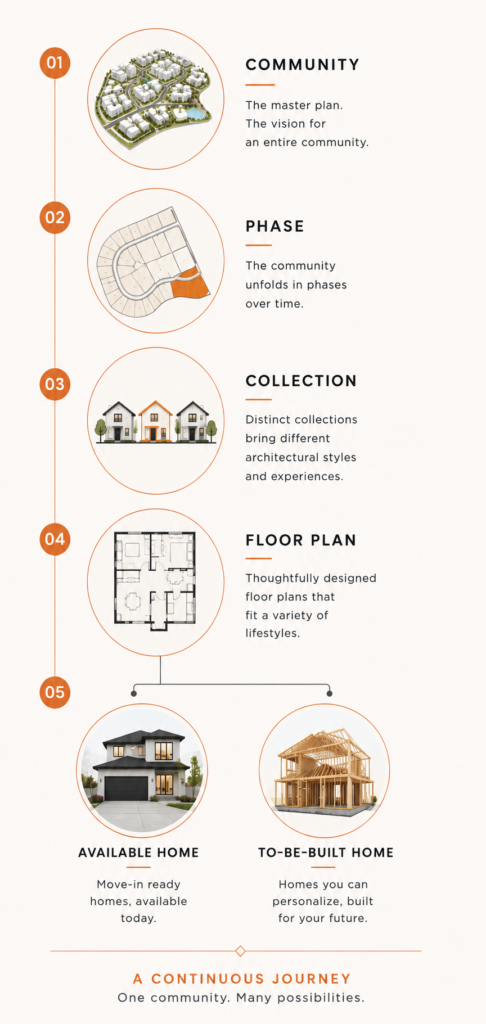
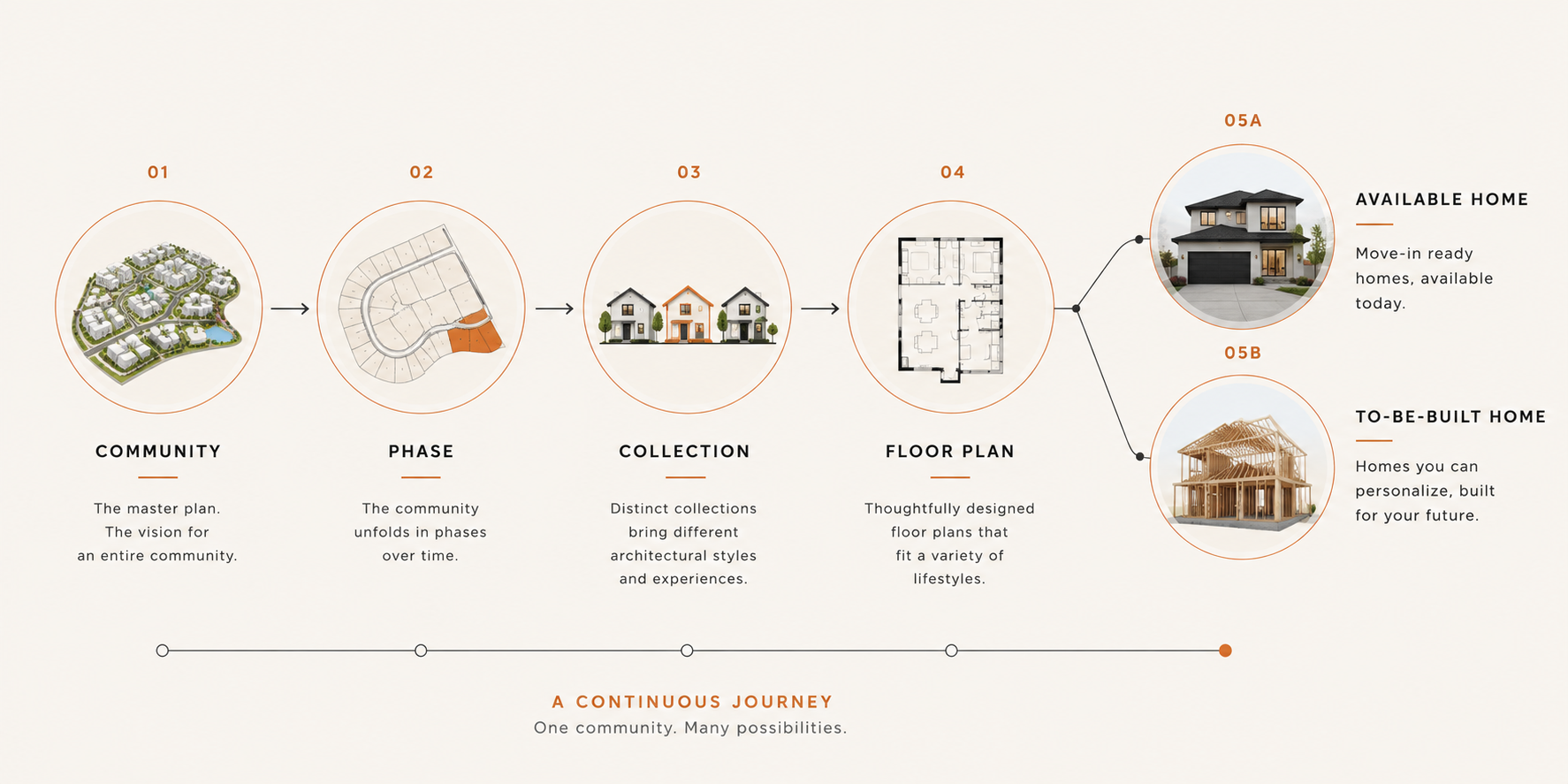
As we have seen, new construction has a timeline that the traditional MLS architecture was not designed to represent. But time is only one dimension. New construction also has a hierarchical dimension:
Community → Phase → Collection → Floor Plan → Available Home / To-Be-Built Home
And once those two dimensions are considered together, something important becomes apparent.
A resale listing is principally a description of what exists. A new construction listing must also describe what is becoming.
That is a very different information problem.
A buyer considering resale can compare one existing property with another. A buyer considering new construction may be comparing a move-in ready home with a home that will be ready in a few months, or one of several floor plans that can be built on a homesite available today, or another opportunity in a future phase yet to be released.
All four possibilities are part of the market.
This is why representing new construction cannot begin and end with the individual property. The home makes sense only within the project from which it emerges, and the project makes sense only when its evolution through time can also be understood.
For decades, the industry has managed this complexity through a fragmented collection of distribution mechanisms: builder websites, broker relationships, inventory and pricing reports, emails, spreadsheets, and, more recently, B2C digital portals.
That fragmentation creates friction. For real estate professionals, even basic questions about new construction can require navigating multiple sources, systems and formats. The contrast with resale is striking: information readily accessible through the MLS may require considerable effort to find, verify and assemble in new construction.
For many agents, the friction is enough to discourage them from selling new construction altogether.
The industry has information. What it has never had is a shared professional system designed to organize and distribute that information while preserving the relationships within a project as it evolves.
That is the first idea behind a Global Listing Service.
And the history of the MLS reveals something else.
The Geography Dimension
Those San Diego brokers in 1885 were not creating the first piece of a national system. They were solving a local problem. Brokers elsewhere did the same thing. The MLS spread across America not through the construction of one network, but through the replication of an idea.
City by city. Board by board. Market by market.
For most of its history, that made perfect sense. Real estate was intensely local. Technology was local. Professional organizations were local. Regulation was largely state-based. So the infrastructure followed the geography of the industry.
The result, more than a century later, was not one American MLS but hundreds of them.
As recently as 2015, roughly 850 MLSs operated across the United States. By the end of 2025, that number had fallen to 484 as neighboring organizations merged and larger regional systems emerged.
There is a certain historical irony in this.
The MLS spent more than a century expanding outward from local markets and is now confronting the need to connect across the boundaries inherited from that history.
A system created today does not have to repeat the journey.
It can begin with the lesson at the end of it.
That matters because the market itself no longer stops neatly at county or state lines. Millions of Americans move between states each year, while millions more from around the world relocate to the United States. Real estate professionals increasingly serve clients whose housing search begins in one market and ends in another, whether across a city, a state, or an international border.
A family leaving New York for Florida does not experience housing as two disconnected markets. Neither does an agent helping that family relocate. Nor does a Brazilian family preparing to move to Orlando.
Their search crosses a boundary. The information system should not have to.
That is what Global means in Global Listing Service.
Not simply international. Not merely multilingual.
Global describes the architecture itself: one connected system, conceived without the geographic boundaries that earlier generations of real estate technology inherited.
New construction needs a different information architecture because it exists not merely as individual properties, but as projects unfolding through time.
And that architecture can now be built as a connected system from its inception rather than reconstructed, decades later, from hundreds of local ones.
This is the category NEO was created to establish: the Global Listing Service for New Construction.
The MLS gave resale real estate a shared professional language for describing what is for sale.
NEO carries that principle into another dimension: communities, phases, collections, floor plans, available homes and homes yet to be built, continuously connected to the projects from which they emerge.
There is no need to diminish one system to make the case for the other. In fact, the opposite is true.
The strongest argument for the GLS may be the history of the MLS itself.
It showed what happens when an industry creates shared infrastructure around the way its market actually works.
New construction now has the opportunity to do the same, with one advantage its predecessors in 1885 could never have imagined:
It can begin connected.